Showing posts with label Vilasini Natyam. Show all posts

February 11, 2013

The revival of dance as temple ritual

Last year I had the opportunity to travel to Hyderabad and witness the temple rituals performed in the Sri Ranganathaswamy Temple during its Brahmotsav celebrations. The experience was a very special and unique one because this is the only temple where dance is performed as part of worship today. In the following article I tell the story of how dancer Swapnasundari was able to reinstate and perform the ritual dances of Vilasini Natyam in this small temple on the outskirts of Hyderabad.

Many of India’s classical dance traditions originated in the temples, where dance was presented as a sacred ritual offering to the deity. Eventually Indian classical dance moved from these sacred spaces to performance venues, where it is performed today as entertainment to large audiences. Meanwhile, the temple has become a popular scenic backdrop for dance festivals like Khajuraho, Chidambaram and Mukteshwar.

But in a small, scenic temple in Rang Bagh on the outskirts of Hyderabad, in India’s southern state of Andhra Pradesh, the ritual and ceremonial dances which were once performed by temple dancers known as saanis or bhogams have been revived and reintroduced as a part of worship during the temple’s annual Brahmotsav celebrations. These dance rituals have been restored by the temple authorities through the active collaboration of renowned dancer Swapnasundari, who after making a name for herself as a Bharatanatyam and Kuchipudi dancer, dedicated herself to learning and reviving the dance of the Telugu-speaking regions, which is known today as Vilasini Natyam.

The opportunity to reintroduce these ritual dances as a part of temple worship seemed destined to happen. While performing at a dance festival in Kottakkal, Kerala, Swapnasundari explained to the audience that a ritual form of the dance Vilasini Natyam had been performed in the temples of South India. Sitting in the auditorium was Mr Sharad B Pitti, the chairman and managing trustee of the Sri Ranganathaswamy temple in Rang Bagh. After the performance, he told Swapnasundari about his wish to revive the traditional rituals of the temple, including the dance rituals. “We would go to the temple every year for the Brahmotsav celebrations but the festival had shrunk from what it once was and should be,” he explained. “It was important for me that the rituals should be done in the right way and that justice be done to them. Since dance was an integral part, we had to include it to make the festival complete. I invited Swapnasundari to Rang Bagh because we were interested in reviving dance as part of the temple rituals.”

For Swapnasundari, this opportunity must have seemed like a gift from the gods: “I was eagerly waiting to dance the rituals in their original setting and context,” she said, “rather like a professor of chemistry waiting to find the appropriate laboratory where his or her wonderful formula could be applied in practice! But no temple came forward before the Rang Bagh trustees did.” This opportunity to reinstate and perform the ritual dances of Vilasini Natyam in a temple setting seemed serendipitous and almost a natural result of her efforts to research, document and teach this dance which was once in danger of being forgotten.

What followed was a long process of research and investigation to piece together the rituals in order to be able to reproduce them as authentically as possible. Mr Pitti described the process: “We looked through ancient texts and heard there was a man who had a few books on these rituals. We managed to contact him and he let us photocopy them. They were in Sanskrit and Telugu. Swapnasundari worked very closely with the temple priests to identify and recreate these rituals. What we have now is a refined and filtered version which is the result of a long process.” With great effort, Swapnasundari even managed to contact the daughter of a temple dancer who had been consecrated to this temple. It took much pleading and insistence but she eventually agreed to come to the temple and show Swapnasundari the rituals her mother used to perform.

Using these references and inputs, Swapnasundari was able to identify the dance rituals which were once performed by the temple dancers of Sri Ranganathaswamy temple. These were first reintroduced in 1996 during the temple’s Brahmotsav celebrations, choreographed and performed by Swapnasundari. Today, she and her disciples take turns performing the ritual dances during the eight days of the annual festival which usually falls in February (see below for the 2013 dates).

The Sri Ranganathaswamy temple in Rang Bagh is the only temple where ritual dances are performed as part of worship today. Swapnasundari teaches Vilasini Natyam free of charge so that this tradition can continue. “This is my way of giving back to the temple an aspect of the art which has been taken away from it. I give free classes in the temple-ritual dances of Vilasini Natyam to those who value my sentiment and offer what they learn as service to the temple once a year.”

For the dancers performing these age-old rituals, it is a special experience which goes far beyond a stage performance. “It is a Seva (service) not a performance,” feels Purva Dhanashree. “It’s part of something bigger. On stage it’s all about you. Here you’re just a dot in the pattern. It’s an inner journey.” Anupama Kylash echoes this sentiment: “It’s an internalised experience. I address myself to Him; it’s a dialogue with Him in my thoughts.” Sanjay Kumar Joshi is the only male dancer performing these ritual dances. “For me it’s a divine experience. I perform the dance only for God,” he says. “We want the dance back in the temple, in its context. There are no consecrated temple dancers here, so we perform these sacred ritual dances.”

A description of some of the dance rituals:

The first daily ritual is the Balabhogam when the first food offering of the day is made to the deity. The temple dancer invokes the deity with a hymn called Choornika followed by a Pallavi, an item of Nritta, or pure dance. At 11am and 8:30pm, before the temple idols leave the temple on a palanquin, Baliharanam is performed, followed by the Pallaki seva when they are taken outside the temple, and the Kumbha Arathi and Heccharika on their return.

During Baliharanam, the Ashta Dikpaalakas, the guardian deities of the eight directions, are invoked in a ritual where each deity is asked in turn to provide protection in preparation for the journey outside the temple. After invocations to Brahma and Garuda, the priests, dancers and musicians move in a clockwise direction around the temple, pausing at each of the eight points which are clearly marked by small raised platforms. Starting to the east, Indra is the first guardian-deity to be invoked followed by Agni, Yama, Nirrti, Varuna, Vayu, Kubera and Isana. At each of the eight points, the priests chant prayers in sing-song unison, followed by a loud rhythmical introduction of the Tavil and the Nattuvangam before the singer and flutist join in and the dance begins. Swapnasundari has reclaimed all the obsolete Talas related to this ritual and re-incorporated these into the chorography of this ritual.

With the invocations to the Ashta Dikpaalakas complete and their protection of the temple ensured, the palanquin moves out of the temple compound in a procession. The procession stops on the way, so that devotees can offer their prayers and offerings. At each halt, the dancer dances to a verse of a devotional hymn. By the time the procession completes its journey, an entire song or set of songs would have been completed. This ritual is called Pallaki Seva.

Before re-entering the temple, the palanquin stops just outside the main doorway for the Kumbha-harathi. The temple priest lights a lamp which is placed in a pot. Accompanied to the music of a Mallari, the dancer takes the pot and performs Arati before the deity and then walks around the palanquin. This is an act of purification before it re-enters the temple.

This is followed by the singing of a Heccharika. Through mimed movements, the dancer requests the deities to re-enter the temple with caution as ‘undesirable elements’ may have entered the temple in their absence. At the same time she warns these negative elements to leave the temple premises.

These are the three rituals performed daily. During the Abhisekam (sacred bathing) and Kalyanam (wedding ceremony) of Sri Ranganathaswamy and Maha Lakshmi, other dances are also performed.

This article was published in the September 2012 issue of Avantika magazine.

This year, Sri Ranganathaswamy Temple celebrates its Brahmotsavam from February 17 to 24, 2013. The dance rituals take place every morning and evening until February 22nd.

In 2014, the Brahmotsavam will take place from February 7 to 11.

Address: Sri Ranganathswamy temple, Rang Bagh, Nanakaramguda, Hyderabad

October 30, 2011

Preserving traditions


India has an incredibly rich cultural heritage. There are hundreds of performing art forms, including theatre and drama, dance, martial arts and musical traditions, both classical and folk. Some of these traditions are better known than others, and as a result, are given more opportunities to be showcased. While there is a proliferation of performances of dance forms like Bharata Natyam, Kathak and Odissi, there are few opportunities for audiences to see other, lesser known performing arts traditions like Sattriya, Kutiyattam, Chhau and Vilasini Natyam. Chances are that many people may have not even heard of these art forms, let alone had the opportunity to experience them.

Why is it that some performing arts are better known and more popular than others? Are those which have been given the classical ‘tag’ somehow entitled to more recognition and seen to have a higher value? This brings up some pertinent questions: What makes a dance ‘classical’? Does a dance form need to be a granted a ‘status’ to be recognised and valued?

Despite their different names (and classifications), many of India’s performing arts traditions actually have a lot in common. They have their origins in the Natya Shastra, the ancient text on dramaturgy written in the 2nd century by Bharata Muni and thus share many of the same principles. For example, they feature aspects of nritta (pure dance), nritya (expressive dance) and natya (drama). They have a sacred and ritualistic aspect and were often performed in holy places like temples or monasteries. Today these performing arts traditions have been adapted for presentation on the stages of metropolitan cities and each has developed a distinctive performance repertoire.

Many of these traditional performing arts also went through a period of precariousness and faced many challenges to their continued existence. When support structures and patronage to these arts performed in temples and courts were disrupted, the development and continuation of these forms was interrupted. Following Independence when there was an increased interest in India’s artistic heritage, some dance traditions experienced a renaissance and rebirth. They were adapted for the modern stage and entered a new period in their development. Because of this historical interruption followed by revival and reconstruction, most performing arts traditions we see today can really only be considered to be ‘neo-classical’ as they are reinvented versions of their former selves.

Today a performing art form tends to be classified as ‘classical’ if it has its origins in the Natya Shastra and features, as mentioned previously, elements of nritta, nritya and natya. Despite the fact that many of India’s performing arts traditions trace their origins to the Natya Shastra, it is generally claimed that there are only eight classical dance traditions.

In 2000, Sattriya became India’s ‘eighth classical dance’. Recognition of its classical status was granted much later than other dance forms. Anwesa Mahanta, Sattriya dancer and research scholar, explains that Sattriya’s important ritual aspect perhaps kept it out of public view. “The art form is practiced as a ritual, as a ceremonial offering in the namghar,” she says. “Although the local people of Assam accepted and embraced the art form, the vision of the status of classical developed later. What was more important was the celebration of sacredness of the art form, and even today in villages, namghars and Sattras, Sattriya music, dance and theatre are offered as a ceremonial ritual. This ritual association might have kept away the tradition from the outside onlookers. The geographic insularity of the region might also be another reason.” (Left: Anwesa Mahanta)

Originating in the 15th century, Sattriya is traditionally performed as a ritual form of worship by male monks in the Sattras or monasteries of Assam. Today the form has moved to the stage and is also performed by women. In contrast to the history of other Indian performing arts forms, Sattriya has remained a continued living tradition, explains Mahanta: “Sattriya was never a dying tradition. The tradition has continued as a living art form which has been pursued since the 15th century. The lamp which was lit by the Assamese saint-poet Srimanta Sankardeva was carried out by his disciples with utmost devotion. Even when the soil erosions of Majuli island threatened the precincts of the Sattras, the monks pursued the art form. Hence even today, Sattriya dance is highly regarded as a living art and more than that, a sacred art which has continued, and been practiced and preserved since the 15th century.”

An example of a dance tradition which was at risk of vanishing and has more recently gone through a revival is Vilasini Natyam. This was the dance tradition once performed in the temples and courts of Andhra Pradesh and other Telugu-speaking regions of South India by hereditary dancers. While other dance forms of South India went through a period of revival following Independence, Vilasini Natyam remained in their shadow. By the 1950s there were very few performers left and it was in danger of disappearing altogether. Through the hard work and perseverance of the renowned Bharata Natyam and Kuchipudi dancer Swapnasundari, this dance form has been resurrected and revived. She has made many efforts to preserve this dance tradition: by researching and documenting its oral tradition, publishing a book on its origins, development and revival, and performing to audiences and teaching dedicated students. She has also taken the dance back to the temple where the ritual and ceremonial dances of Vilasini Natyam are performed every year as part of worship at the Sri Ranganatha Swamy temple in Rang Bagh, Hyderabad. (See image right)

These preservation efforts will ensure Vilasini Natyam’s continuation and promote an increased interest in this dance tradition. But attaining official recognition is a bigger challenge. Despite its classical structure, Vilasini Natyam is not considered by some to be a classical tradition. But according to Swapnasundari, this question of status is irrelevant. “Though I was already an established and successful exponent of two such ‘classical’ dance-forms, I started focussing on Vilasini Natyam. I did not require to know of its ‘status’ then, nor does it bother me now. After I started to perform this style all over the country, it received critical acclaim at the national level. No one has been bothered about its ‘status’ when they enjoyed the dance-form. Vilasini Natyam has already covered a lot of ground and has made its place in people’s hearts. This style continues to be featured in the best platforms before real connoisseurs. This question therefore bears relevance for the coming generations of Vilasini Natyam dancers. People who have seen Vilasini Natyam over the years tell us that they are shocked and surprised that national and international bodies still choose to remain aloof. This is an abdication of responsibility by these organisations towards the future generation of Vilasini Natyam dancers, some of whom are making good stride as performers.”

The concerted efforts of practitioners and teachers towards the propagation and preservation of a classical art form does much to advance its cause. There are also efforts at the national and international levels to recognise the classical traditions and in this way offer more visibility and recognition. Through its goal to protect and preserve cultural heritage and improve awareness of its significance worldwide, UNESCO established the Representative List of Intangible Cultural Heritage. Currently there are eight Indian performing arts forms included on this list, including Chhau and Kutiyattam.

Chhau is often described as a martial art form though it also uses folk and tribal traditions and yet also has classical elements of nritta, nritya and natya. “Chhau is classified as semi-classical,” explains Bhubaneswar-based Odissi and Chhau performer and teacher, Ileana Citaristi. “This is because the martial art and folk elements from which it has derived are still more predominant than the classical ones.” There are three different forms of Chhau: Seraikhella and Mayurbhanji which originated in the state of Orissa and Purulia from West Bengal. Today Seraikhella is located in Jharkand and Mayurbhanji in Orissa. Seraikhella and Purulia are performed with masks, while Mayurbhaji is the maskless form of Chhau. Chhau was traditionally performed exclusively by men and flourished under royal patronage. “Soon after Independence, the Oustads (masters) had a tough time to survive since the patronage by the Royal family was withdrawn,” says Citaristi. “It took quite some time before government intervened.” Has UNESCO status furthered its cause? Seeing that recognition for Chhau was granted only in 2010, Citaristi, thinks only time can tell: “It is too recent to say and in any case it is not very clear if recognition has been granted for the three forms of Chhau or only for Seraikhella. It may help in achieving the status of classical or in being recognized but it is not enough. Exponents of the particular art form should also stand out for their own merits.” (Image above: Mayurbanji Chhau courtesy of Ileana Citaristi)

Kutiyattam, the Sanskrit theatre form from Kerala was recognised as ‘intangible cultural heritage’ by UNESCO in 2001. Dating back over 2000 years, this is one of the oldest living theatre traditions. Traditionally performed in Kuttampalams, theatres located in Hindu temples, it was reserved for a particular Brahmin caste, the Chakyars. Performed in Sanskrit, performances would last for hours, and often went on all-night or for several days. Today it has been adapted for the modern stage: plays have become shorter, the pace has been quickened. Kutiyattam has also faced its own challenges: rapid and social changes have compromised its continuation in an unadulterated form. “Social changes happening everywhere affected Kutiyattam too,” explains K. K. Gopalakrishnan, director of the Centre for Kutiyattam in Trivandrum. “British rule was disastrous to cultural heritage, temples became poor and peoples’ priorities changed. Few have the time to watch performances which last a full night and even whole days. Other factors which put the tradition at risk were the fading of the joint family system, changes to the class system, population movement and opportunities for high-income employment. On the other side, temples became poor due to social changes and income from the performances declined. As a result, fewer people are committed to take up the art. But even then, a few gurus of each generation preserved the art and never allowed that fire to die. For example, in 1956 late guru Painkulam Ramachakyar took Kutiyattam outside the temple precincts amid strong opposition from his own clan and the orthodox and in 1965 the Kerala Kalamandalam institutionalised the training of Kutiyattam by starting a course for the first time outside the home of a Chakyar. In this way Painkulam was the first guru to train members of other communities to take up the art.” (Image above by KK Gopalakrishnan)

And has UNESCO status helped to preserve this ancient theatre form? Gopalakrishnan remains optimistic: “In the changing social scenario such recognition helps, for example, to get more outreach and funding and it also gives more global publicity to the form. But one should not forget that the system is sustained only through committed gurus and devoted disciples who are prepared to preserve the form at any cost and not only through any such mere recognition.”

An abridged version of the article was published in On Stage magazine in September 2011.

July 10, 2011

An urge to explore the unfamiliar: An interview with Swapnasundari


In a previous post, I wrote about the launch I had attended of

Swapnasundari's book on Vilasini Natyam. This is a dance form which she has spent years learning, researching and documenting. In a recent e-mail interview, she told me more about her artistic journey and the origins and revival of Vilasini Natyam.

You have had an interesting journey as a dancer. While most dancers devote their lives to a single dance style and focus on a career as a performer, you have not been afraid to change trajectories and explore other dance forms and fields. At the height of your Bharatanatyam career, you turned to Kuchipudi and later you devoted yourself to the revival of Vilasini Natyam. What was the catalyst which inspired you each time to change direction?

I agree that my artistic journey has been very untypical. The change in my trajectory has been spurred by many factors. Both my mother and maternal grand-mother were knowledge-seekers and enthusiastic explorers of new skills. Perhaps I am similar to them because of genetics. I sincerely believe that continuous growth is essential for an artist. Normally this is forgotten when people become established and popular performers.

Whenever I have sensed stagnation in the external environment, I have sought to build an artistically rich inner world. I frequently evaluate my relationship with the external world and my internal world and I try to achieve a balance, in order to maintain harmony with both these worlds. This is a difficult exercise but necessary for a meaningful life. I am hungry for learning. I feel a latent urge to explore the unfamiliar. I am excited by whatever I pursue at any point of time and like to test my potential for meeting the challenge offered by each new idiom. Other than dancing three dance-styles, I also sing, teach and write.

Both Kuchipudi and Vilasini Natyam have their origins in the Telugu-speaking region of India. How are they similar and dissimilar?

There is no direct relationship between the Kuchipudi and Vilasini Natyam. In fact, one can discern some similarities between Vilasini Natyam, Bharata Natyam and Odissi. The historical connect between the solo Bharatham forms which were danced in these parts of southern and south-eastern India has been discussed in my book on Vilasini Natyam (Vilasini Natyam: Bharatam of Telugu Temple and Court Dancers). Interestingly, the Telugu hereditary dancers of Vilasini Natyam from whom I have learnt, have never studied from Kuchipudi masters. Most of them had not even seen Kuchipudi until television entered their lives. The name of the late Balasaraswati is unknown to them as is that of Odissi dance.

Physical behaviour, mannerisms, language, customs, and preferences of people invariably leave a characteristic stamp on art-forms practiced in the same region, as is the case with the female solo-forms of Mohiniattam and Nangyar Koothu and the male dance-theatre Kathakali, all of which belong to Kerala. Similarly, any passing resemblance between Kuchipudi and Vilasini Natyam is an outcome of their shared culture.

Though some similarity between Kuchipudi and Vilasini Natyam is discernible in the operatic repertoire, the differences are many. The Northern and coastal school of Vilasini Natyam alone contains over 100 basic adavus and their permutations and combinations. Another 35 to 40 Nrittha units belong to its Southern school. None of these find place in the Kuchipudi Sampradayam taught to me by its traditional male Gurus. Equally vast and varied is the Abhinaya repertoire and methodology earlier followed by the Telugu hereditary female dancers which continues today in Vilasini Natyam. All this differs from what is currently taught and performed in Kuchipudi.

You have learnt from dance gurus as well as from hereditary temple-dancers. How has the experience been different? Is one experience more ‘authentic’ than the other?

So far as traditional performing arts are concerned, I do not ascribe much importance to claims of ‘purity’ and ‘authenticity’ which are frequently heard. Every so-called ‘authentic’ tradition that we see today is the product of re-invention and recasting by succeeding generations of exponents and teachers. Adaptations have always taken place as and when necessary.

In Kuchipudi, the operatic tradition has all but disappeared and solo Kuchipudi dance is more sought after now. Sweeping changes and innovations which have been made in Kuchipudi over the last fifty years may have even rendered it unrecognisable to the generation which has lived through this period.

In the case of Vilasini Natyam, its new performers including myself, do not belong to the Devadasi community. We are representing the art-form in a new context. We dance in a different forum (the proscenium stage), not in the royal court or the temple (except in the annual temple-festival of Rang Bagh).

I respect the art which has been taught by my Bharata Natyam and Kuchipudi gurus as well as my devadasi Gurus. They have sincerely bequeathed to me what they had inherited and nourished assiduously through their lives. Now it is for me to handle this inheritance carefully and take it further. As has been happening over past centuries, it is natural that the dance-styles I perform and teach would acquire new dimensions through my interpretations.

Why didn’t Vilasini Natyam receive the same attention as other dance forms post-independence?

Though I have mentioned some key facts in my book, it is the cultural administrators of our country who have to answer this question. I pursue Vilasini Natyam for purely artistic reasons.

The public-funded cultural councils of the government of independent India were already in place when I was born. The policies and guidelines followed by these councils appear to be susceptible to various pulls and pressures. I am not a part of any lobby, political or otherwise. Maybe this is the reason why organisations such as Sangeet Natak Akademi do nothing to support my efforts. There can be no other reason, because Vilasini Natyam as an art-form has already gained great appreciation amongst connoisseurs as well as the discerning media.

You have taken Vilasini Natyam not only to the stage but also back into the temple during an annual festival at a temple in Hyderabad. Does this feature the ritual and ceremonial aspects of the dance?

It is only the ritual and ceremonial dances of Vilasini Natyam that we perform annually in Sri Ranganatha Swamy temple in Rang Bagh, Hyderabad. These ritual-dances (called Agama Nartanam in Sanskrit and Gudi-Seva in Telugu) can be seen here every day during the Brahmotsavam, which usually falls in the months of January-February. As a part of worship in the temple, we dance these to the accompaniment of religious chanting and traditional music that includes ancient talas and rare ragas. Every Vilasini Natyam dancer looks forward each year to this one-of-a-kind experience.

Is there anything else you’d like to share with readers?

Besides performing Vilasini Natyam, I have also been teaching it over the past ten years to a select few. Some of my disciples are multi-stylists, like myself. Their experience while dancing Vilasini Natyam appears very similar to my own. They tell me that they feel ‘centered’ and sense a certain kind of ‘inner equanimity’ within themselves, not just while dancing temple-rituals but even during their stage concerts of Vilasini Natyam.

I can’t help thinking that indeed, this is the true purpose of art. If I am able to lead people there I am deeply honoured and humbled, especially by the fact that it is the honest art of the much-maligned Telugu Devadasi and the proud artistic legacy of the Telugu Rajadasi that has brought me so close to the core of dance.


This article was published in the Summer 2011 issue of Pulse magazine.


March 5, 2011

Vilasini Natyam: A dance tradition revived

While I was in Chennai in December, I had the opportunity to attend the book launch of Swapnasundari’s book on Vilasini Natyam. Vilasini Natyam: Bharatam of Telugu Temple and Court Dancers tells the story of this dance tradition which was once performed in the temples and courts of Andhra Pradesh and other Telugu-speaking regions of South India.

Bharatam is a generic term which refers to the performing arts which have their origins in the Natya Shastra, Bharata Muni’s classical treatise on the arts. Every Indian classical performing art is therefore a form of Bharatam which then developed its own unique features over time in its region of origin. The Bharatam of the Telugu temple and court dancers – now referred to as Vilasini Natyam – did not go through a period of revival like many other Indian classical dance styles did around Independence, a period of cultural revival. By the 1950s there were very few active performers and this unique dance tradition was in danger of disappearing altogether.

Swapnasundari, the book’s author, is a renowned Bharata Natyam and Kuchipudi dancer who rose to fame during the 1980s. She is the recipient of many prestigious awards, including the Padma Bhushan which she was conferred at a young age. Her dance career suddenly moved in a different direction after she had the opportunity to see an ageing temple dancer, Madulla Lakshminarayana, present a short performance in a small town in Andhra Pradesh. This was a life-changing experience. As Swapnasundari watched her from the audience, she was deeply moved. “The power of her art came like a flash. I was simply staggered and humbled by it. I told myself this is where I want to go, become an artist, not a dancer. I had everything going – youth, fame, affluence, popularity and she had nothing. But what she had I had not acquired in 25 years of dancing. She wiped away my sense of achievement.” (Source: The Times of India Crest Edition, 22 January 2011)

For the next five years, Swapnasundari took a break from her prolific dance career to follow her newfound passion. She travelled all over Andhra Pradesh and neighbouring Telugu-speaking regions to meet and interview the hereditary dancers of this dance tradition. She carefully documented everything she learned. She also had a great desire to learn this dance herself. It was only after a great deal of persuasion that some of these hereditary dancers agreed to teach her.

Speaking at the book launch, she described the challenges of learning this dance:

“What I learned from these hereditary dancers was what they had preserved. This had plus points and minus points. I was not getting a very sophisticated version of the Bharatam of the Telegu temple and court dancers. I was getting it in a raw state. And it was for me to adapt it in the way I was required to do for my time. That’s a plus point. The minus point was that they were not used to teaching it as a system in a way that we are used to. When studying a classical dance, you usually start with adavus and then go on to items, etc., but here there was no such system. Since they had never followed such a system, they did not dream of teaching in such a way. So my first guru would make me do a few adavus and then after a while she would start singing a padam, or whatever item I was learning. After she had finished singing the pallavi and anupallavi she would simply move to something else, like the abhinaya of a sloka. After teaching me two lines she would take a break and when she came back she would start teaching me something else. For me this was terribly confusing because I thought I would learn in a vertical way and go deeper and deeper whereas she was going in a horizontal way and trying to teach me all aspects at the same time, bit by bit. Much later I adapted to this system and I would sit with a tape recorder and a notebook and tapes around me and try to take everything down. That was the only way for me to absorb everything that she was teaching me! So there was a practical difficulty in reclaiming this material. Also, I had to struggle to disinherit my training in Bharata Natyam and Kuchipudi. So those dynamics had to be disinherited in a sense and I had to start from zero.”

She spent years learning and researching the dance, contributing significantly to its revival. In 1995 the dance form was renamed Vilasini Natyam. Previously this performing tradition was referred to Bharatam, Karnatakam or Tsaduru, among other names. She now performs and teaches Vilasini Natyam to a dedicated group of students. Every year along with her students, she presents a traditional recital of Vilasini Natyam at the 400-year-old Sri Ranganatha Swamy temple in Rang Bagh, Hyderabad. This is an example of how the ritual element of this dance tradition has been reintegrated into temple worship. (Left: Vilasini Natyam dancers at Rang Bagh temple, Hyderabad.)

Swapnasundari’s book Vilasini Natyam: Bharatam of Telugu Temple and Court Dancers explores the history and revival of this dance form which was performed exclusively by hereditary female dancers. It gives an account of its origin, rise, decline and renaissance into the form Vilasini Natyam.

The book opens with a dedication by Joseph Campbell which was a pleasant surprise for me:

‘Your sacred space is where you can find yourself again and again’

This is followed by a line by Swapnasundari:

‘With gratitude to those who inspired me to find that space.’

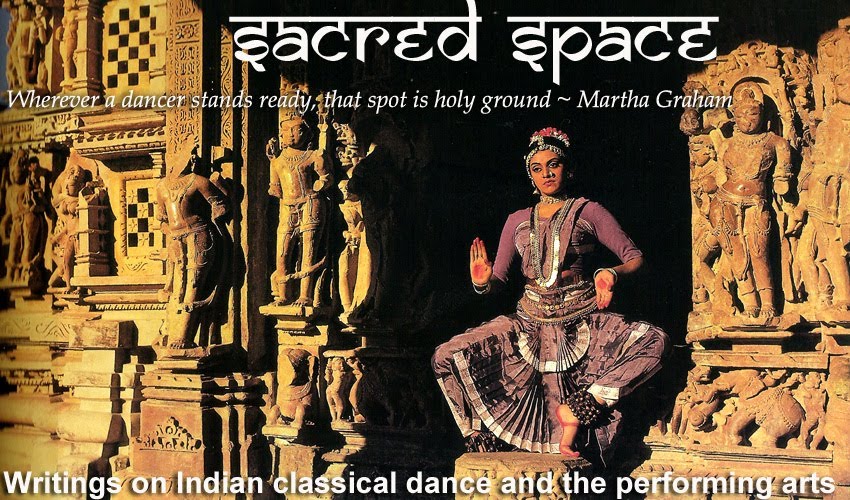
The lovely photo of a dancer posing in a temple in the banner photo of this blog I’ve called Sacred Space happens to be Swapnasundari!


Real Time Analytics